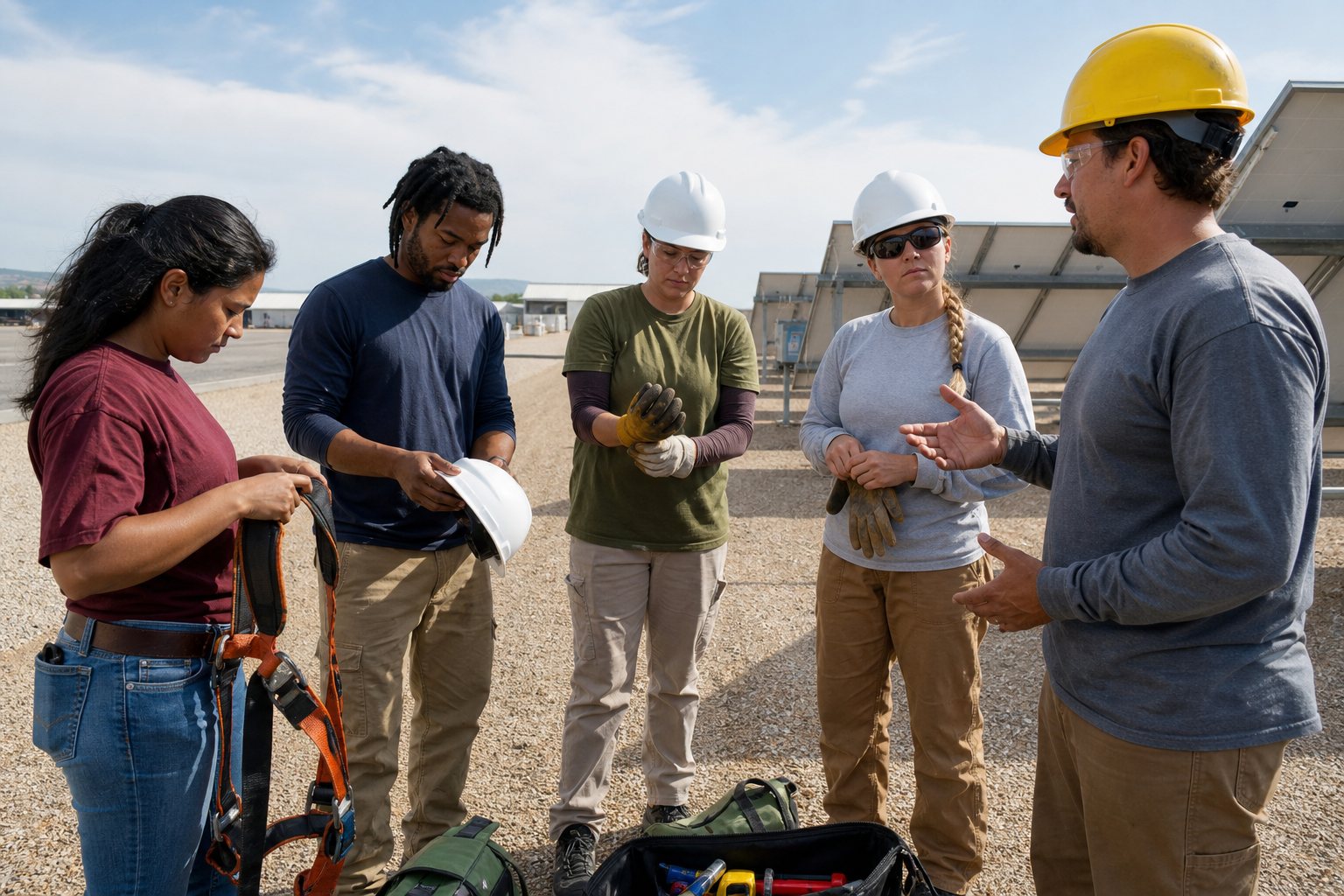
Understand the workday shape
Field work begins before the tool touches equipment. Travel, site access, briefings, permits, material checks, weather review, work-area setup, documentation, and closeout can shape the day. Ask where the shift starts, whether travel time is part of the schedule, how crews receive assignments, and what happens when a site is inaccessible. Remote solar, wind, transmission, and storage locations can have limited services and changing conditions. A realistic picture of the whole day is more useful than focusing only on the technical task.
Treat authorization as a boundary
Training, qualification, and authorization are not interchangeable. A course may introduce a concept without authorizing work on a specific site or system. Employers determine task assignments through their procedures, supervision, equipment, contracts, and applicable rules. In interviews, ask which tasks new hires observe, perform under supervision, and eventually perform independently. Never use a general guide to decide that electrical, energized, climbing, rescue, lifting, driving, or confined-space work is safe for you. Follow the actual employer and site controls.
Prepare for weather and terrain
Outdoor conditions affect pace, access, grip, visibility, hydration, heat and cold stress, lightning decisions, and vehicle movement. The employer should define protective equipment, monitoring, stop criteria, and emergency arrangements. Your job as a candidate is to understand the exposure honestly. Ask about seasonal extremes, shade or warming access, storm protocols, uneven surfaces, wildlife or vegetation, and the distance to medical support. If you need an accommodation, use the employer’s process rather than assuming a physical description settles what is possible.
Evaluate travel and driving
Travel percentages hide patterns. Twenty percent could mean one week each month, frequent single nights, or seasonal concentration. Ask about territory, overnight frequency, schedule notice, vehicle arrangements, expense process, and whether travel increases during outages or construction peaks. Driving may involve trailers, unpaved roads, winter conditions, or long distances after physical work. Verify license and driving-record requirements directly. Consider the effect on sleep, caregiving, and recovery, not just whether you enjoy travel in principle.
Practice communication routines
Field teams depend on brief, accurate communication. Practice stating location, equipment identity, task status, hazard, control, and requested action without burying the point. Handoffs should distinguish completed work, open conditions, temporary controls, and records still needed. If you do not understand an instruction, repeat back what you heard and ask before acting. In an interview, a story about preventing a handoff error can be stronger than one about working fast. Reliability includes making uncertainty visible.
Build documentation habits
Photos, readings, serial numbers, torque records, checklists, issue logs, time entries, and material use may support traceability, but each site sets its own requirements. Practice recording facts promptly and separating observation from interpretation. Learn to preserve revision and asset identifiers. Never share employer or customer records as a portfolio sample. You can create a fictional blank template that demonstrates organization, clearly labeled as your own example, without copying proprietary forms or implying field experience you do not have.
Ask about emergency preparation
Remote work requires clear escalation, communication coverage, muster points, rescue arrangements, and stop-work expectations. Candidates should ask how new team members learn these systems and how drills or briefings occur. Do not attempt to design or substitute an emergency plan from online advice. Disclose relevant concerns through appropriate channels and understand who supervises the work. A mature answer in an interview emphasizes following the site plan, maintaining communication, and stopping when conditions fall outside the approved work scope.
Use a pre-application fit check
Write honest answers to eight questions: Can I meet the stated schedule? Is the travel pattern workable? Have I done comparable physical work? What conditions are new? Which tasks require employer training? Can I explain a safety decision? Can I maintain attention after travel or during shifts? What must I ask before accepting? Revisit answers after the interview. Readiness is not toughness. It is an informed match between your capabilities, the employer’s controls, and the actual environment.
A practical review worksheet
Before acting on this guide, create a one-page record with four headings: evidence, unknowns, conditions, and verification. Under evidence, write only tasks you personally performed and could explain under follow-up. Under unknowns, list systems, vocabulary, or responsibilities that are new. Under conditions, capture location, schedule, travel, physical environment, supervision, and authorization. Under verification, turn every assumption into a question for the actual employer. Date the page and attach the source link for any live posting. This simple record keeps research separate from claims and reduces the risk of carrying details from one opportunity into another.
Review the worksheet with a trusted person who understands your past work but does not need to know the clean energy sector. Ask them to circle vague statements, unexplained acronyms, and results that sound larger than the action described. Rewrite each circled sentence with a concrete setting, decision, and boundary. Finally, read the employer’s current materials again. If your evidence does not match the core duties, choose a more adjacent route or invest in learning rather than forcing the application. No guide can determine eligibility, safety, or qualification for a specific role; those decisions belong to the employer and applicable authorities.
Keep an opportunity comparison log
Use one row per genuine opportunity and record the official source, date checked, project or asset context, location, employment type, schedule, travel pattern, and application channel. Add separate columns for required qualifications, preferred qualifications, physical or field conditions, and unresolved questions. Do not merge information from similarly titled roles: one employer may use a title for construction support while another uses it for long-term operations. Reopen the source before each interview because dates, duties, or status can change. If the official opening disappears, do not assume a syndicated copy remains active.
Add a decision column after every employer conversation. Record what was clarified, who owns the next step, and which statements still require written verification. Avoid storing government identifiers, financial data, medical information, or confidential documents in a casual tracking sheet. For any work sample, remove employer and customer details and make clear whether it is a fictional demonstration. A comparison log should make your choices calmer, not become a dossier of unnecessary personal data.
Rehearse a verification conversation
Practice asking one question at a time and explaining why it matters. Instead of asking whether a role is “flexible,” ask where the workday starts, how far the normal territory extends, how many overnight trips occurred in a recent representative month, and how schedule changes are communicated. Instead of asking whether training is provided, ask which duties are observed first, which are supervised, how competence is evaluated, and who authorizes independent work. For technical scope, ask what asset phase and equipment family the team supports without assuming that a brand or model is constant across sites.
Listen for distinctions between normal operations and peak periods. Construction milestones, commissioning windows, outages, severe weather, seasonal demand, and customer deadlines can temporarily reshape travel or hours. Ask what is typical, what is exceptional, and how frequently the exception occurred recently. If answers conflict with the posting, request clarification through the verified hiring channel. You are not trying to catch an interviewer; you are building enough shared understanding to evaluate fit responsibly.
Questions to carry forward
- Which three tasks appear most often, and what evidence do I have for each?
- What would I be expected to observe, perform under supervision, and perform independently?
- How do schedule, travel, field conditions, and location change through the year?
- Which stated requirements are role-specific, and where can I verify them?
- What information would make me decline or seek a different route?